Key Takeaway
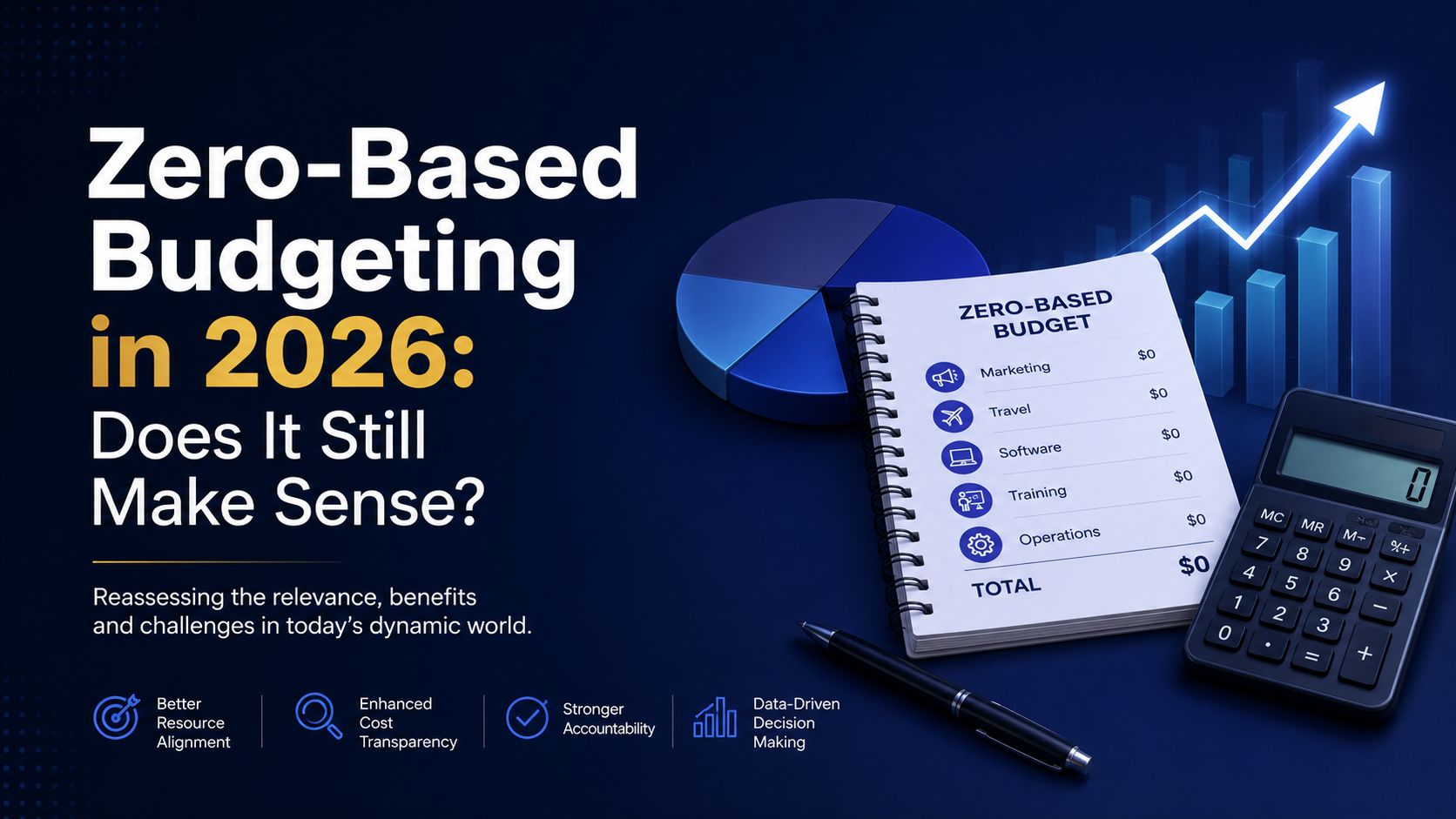
Zero-based budgeting is back on the CFO agenda in 2026, driven by AI cost pressure and board scrutiny. But the evidence on classic, annual ZBB is mixed — it's excellent at producing a one-time cost reset and poor at sustaining discipline over time. The answer isn't reviving the annual ritual. It's applying the principle continuously, and only where it earns its cost.
Zero-based budgeting has died and been resurrected more than once. It first appeared in the early 1970s, when Peter Pyhrr developed it at Texas Instruments and Georgia governor Jimmy Carter adopted it for state government. When Carter became president in 1977, he mandated it across every federal agency — an experiment in making every dollar justify itself from scratch each year. The paperwork burden and bureaucratic resistance overwhelmed the process, and the Reagan administration quietly dropped the mandate in 1981.
It came back around 2010–2014, driven largely by private equity-backed cost discipline at companies like Kraft Heinz, and became a Wall Street-friendly story about disciplined spending. Now, in 2026, it's back again — this time pushed by AI cost pressure, structural cost shocks, and boards demanding sharper accountability for spend.
The question worth asking isn't whether ZBB is trending again. It's whether the version coming back is the version that actually works.
Sit with those last two numbers together. ZBB is genuinely good at producing a large, one-time cost reduction. It is not, at scale, reliably good at sustaining that discipline or converting it into growth — and Kraft Heinz's own experience is the case most often cited: a strategy praised for cost discipline in the mid-2010s that coincided with a 29% share price drop in 2019, as internal accounts described a high-pressure operating environment that undercut the brand investment the business actually needed.
Three forces are pulling it back into CFO conversations right now.
AI Is Creating Costs That Don't Fit the Old Playbook
Model usage, compute, orchestration tooling, and governance platforms are new, variable cost lines that didn't exist in last year's budget. Increasing last year's allocation by a fixed percentage provides little control over spend that has no prior-year baseline to increase from — which is exactly the situation ZBB's zero-baseline logic was built to handle.
Cost Shocks Are Structural, Not Cyclical
Financing costs, tariffs, and input cost volatility are now persistent variables rather than one-off events. That pushes finance leaders toward a budgeting approach that surfaces discretionary and unnecessary spend clearly enough to redirect it quickly.
Boards Are Demanding Sharper Accountability
CFOs are under growing pressure to show that spending is aligned with strategic priorities and delivering measurable value — and a zero-based justification is a clearer answer to a board question than "this is roughly what we spent last year, adjusted for inflation."
The evidence against universal, annual ZBB points to three specific structural problems — not implementation failures at one or two companies, but a pattern across the methodology itself.
It's a Once-a-Year Event Applied to a Continuous Problem
Classic ZBB happens during the annual budget cycle — every line justified from zero, once, then largely locked in for twelve months. But spend conditions and strategic priorities don't hold still for a year. A system built around an annual reset is structurally unable to respond to the eleven months of change that follow, which is why so many ZBB rollouts feel rigorous in January and irrelevant by June.
The Paperwork Burden Creates Its Own Dysfunction
Justifying every line item from scratch generates documentation and review work disproportionate to the strategic value of scrutinising, say, a stable facilities budget with the same intensity as a volatile marketing line. Exhausted teams start rubber-stamping justifications just to get through the cycle — eroding the very discipline ZBB is supposed to create.
It Optimises for Cost Justification, Not Capital Allocation
ZBB answers "can this expense be justified" far better than it answers "is this the best use of this dollar compared to every other option available." A budget that survives zero-based scrutiny with a defensible justification isn't the same as a budget that represents the optimal allocation of scarce capital — precisely the gap that turned Kraft Heinz's cost discipline into a growth problem.
Yes, with a condition: not as a universal, once-a-year, paperwork-heavy ritual applied to every cost line equally — but as a targeted discipline applied where it actually earns its cost, running continuously rather than annually.
The instinct behind ZBB — don't let spend continue by default just because it happened last year — is a genuinely good principle. What doesn't hold up is the specific operational form: an annual, universal, paperwork-heavy justification exercise that overwhelmed the Carter administration's federal experiment in 1977 and that Kraft Heinz's board learned the hard way couldn't scale in 2019 either.
That is a different conclusion from "abandon ZBB." It's a more specific one: apply zero-based scrutiny to the categories where it genuinely adds value — new AI spend, discretionary categories, historically bloated cost centres — and run everything else on a continuously updated, driver-based model instead.
Driver-Based, Continuous Planning Instead of an Annual Reset
Rather than justifying every line item once a year, driver-based planning ties budget allocations to the operational metrics that actually move the business — headcount, transaction volume, customer growth — and updates automatically as those drivers change. This preserves ZBB's core discipline without the once-a-year rigidity that makes it stale by Q2.
Targeted, Not Universal, Zero-Basing
Apply zero-based intensity selectively to volatile, discretionary, or historically bloated categories, while running stable, predictable cost centres on a rolling forecast basis. Gartner's 2026 CFO priorities survey found 51% of CFOs rank improving forecast accuracy among their top five priorities, alongside 56% ranking enterprise-wide cost optimisation — both pointing toward continuous, targeted discipline rather than a once-a-year blanket exercise.
Real-Time Spend Visibility Instead of After-the-Fact Justification
Modern planning platforms enforce discipline transactionally — every purchase, expense, and invoice validated against policy and budget availability at the moment it happens, not reconstructed once a year during budget season. That turns "justify every dollar" from an annual paperwork exercise into a continuous, low-friction control.
AI-Assisted Review Instead of Manual Line-Item Scrutiny
AI can flag line items that deviate meaningfully from operational drivers or historical patterns automatically, so human review time concentrates on the genuinely questionable items instead of being spread evenly and exhaustingly across every line regardless of its actual risk — reducing the administrative burden that sank both the federal ZBB experiment and countless corporate rollouts.
Most organisations don't need to run a full zero-based rebuild across every function. A more practical starting point: pick two or three cost categories where spend is high, fragmented, recurring, or weakly linked to outcomes — common candidates include G&A, procurement, sales and marketing, IT, and discretionary operating expense — and run a genuine zero-based review there, on a two-to-three-year cycle, supported by monthly or quarterly variance reviews everywhere else.
This is exactly where a connected planning foundation matters. Applying targeted zero-basing to a handful of categories while running driver-based, continuously updated forecasts for the rest requires a single planning environment that can hold both models at once — not a spreadsheet rebuilt from scratch for each exercise.
Keansa helps finance teams design planning environments that apply zero-based discipline where it earns its keep, while running the rest of the business on rolling, driver-based forecasts — across platforms including Anaplan, Jedox, OneStream, and Board. That includes decision-package workflows for targeted zero-basing, driver libraries for continuous planning, and the connected data foundation that lets both approaches run side by side without falling back into spreadsheets.
Related Reading
Not sure whether zero-based budgeting still makes sense for your organisation — or which categories it should apply to?
Talk to a Keansa Consultant.png)
.png)
.png)