
Key Takeaway
Excel isn't the problem — it was built for individuals, not for a planning process that now spans entities, cost centers, and stakeholders. The question isn't whether to move beyond Excel. It's how to do it without losing control of the planning process in the meantime.
Let's be honest about something most finance transformation conversations skip over. Excel is not the problem.
For decades, Excel has been the most flexible, accessible, and powerful tool available to finance teams. It adapts to any business model, any reporting structure, and any planning logic a finance professional can imagine. It requires no implementation budget, no vendor contract, and no IT dependency. A skilled FP&A analyst with Excel can build something in an afternoon that would take months to configure in a purpose-built system.
That is not a weakness. That is genuinely impressive. And it is exactly why Excel has remained the default planning tool for organizations of every size, in every industry, for thirty years.
But here is the problem. Excel was built for individuals. And at some point, financial planning stops being an individual activity. When the business grows, the planning process grows with it. More entities. More cost centers. More data sources. More stakeholders who all need to contribute to, review, and act on the same plan at the same time. And at that point, the very flexibility that makes Excel so powerful starts working against the finance team.
The question is not whether to move beyond Excel. For most growing organizations, that decision has already been made for them by the complexity of the business. The question is how to make that transition without losing control of the planning process in the meantime.
There is no universal threshold at which Excel becomes insufficient. But there are patterns that show up consistently across organizations that have outgrown it.
The Version Control Problem
The finance team is working from five different versions of the budget model. Nobody is certain which one is current. A critical formula was changed in one version and not in the others. The consolidation process at month-end involves manually reconciling files that were built by different people at different times on different assumptions. The process works, after a fashion. But it is fragile, and everyone in finance knows it.
The Collaboration Bottleneck
Only one person can work in the model at a time. Business unit leaders submit their inputs via email. Someone in finance manually copies those inputs into the master file. Every submission creates a new reconciliation task. Every change request means going back through the same manual process again. The budget cycle takes three months not because the modeling is complex, but because the logistics of coordinating inputs across the organization are.
The Visibility Gap
Leadership wants to know where the business stands against plan. Finance needs several days to pull the data, build the report, and validate the numbers before anything can be shared. By the time the analysis lands, it is already a week out of date. Decisions are being made on information that no longer reflects current reality.
The Scenario Planning Ceiling
The CFO asks for three scenarios: base, upside, and downside. The team builds them. Then market conditions change, and the CFO asks for two more. Each scenario is a separate file. Updating assumptions across five files without introducing errors requires a level of manual discipline that is increasingly difficult to sustain as the business becomes more complex.
The Governance Problem
There is no audit trail. There is no way to know who changed what, when, or why. When a number looks wrong in a board presentation, the investigation process involves opening multiple files, tracing formulas backward, and hoping the person who built the original model is still with the organization.
Any one of these issues is manageable. Together, they represent a planning infrastructure that is no longer fit for the scale and complexity of the business it is supposed to support.
Connected planning is not a product category. It is a planning philosophy.
At its core, it means building a planning process where financial plans, operational plans, workforce plans, and commercial plans are built on shared data, shared assumptions, and shared visibility, so that when something changes in one part of the business, the rest of the plan reflects that change automatically.
In a connected planning environment, business unit leaders enter their assumptions directly into a centralized planning model rather than submitting spreadsheets via email. Finance teams spend their time on analysis and decision support rather than data consolidation and version reconciliation. Scenario modeling is built into the process, so leadership can see the financial implications of different business decisions in real time rather than days later. And the audit trail that governance and compliance require is built in by default, not assembled retroactively.
None of this requires abandoning Excel entirely. The goal of connected planning is not to eliminate Excel — it is to remove Excel from the parts of the planning process where its limitations create the most risk.
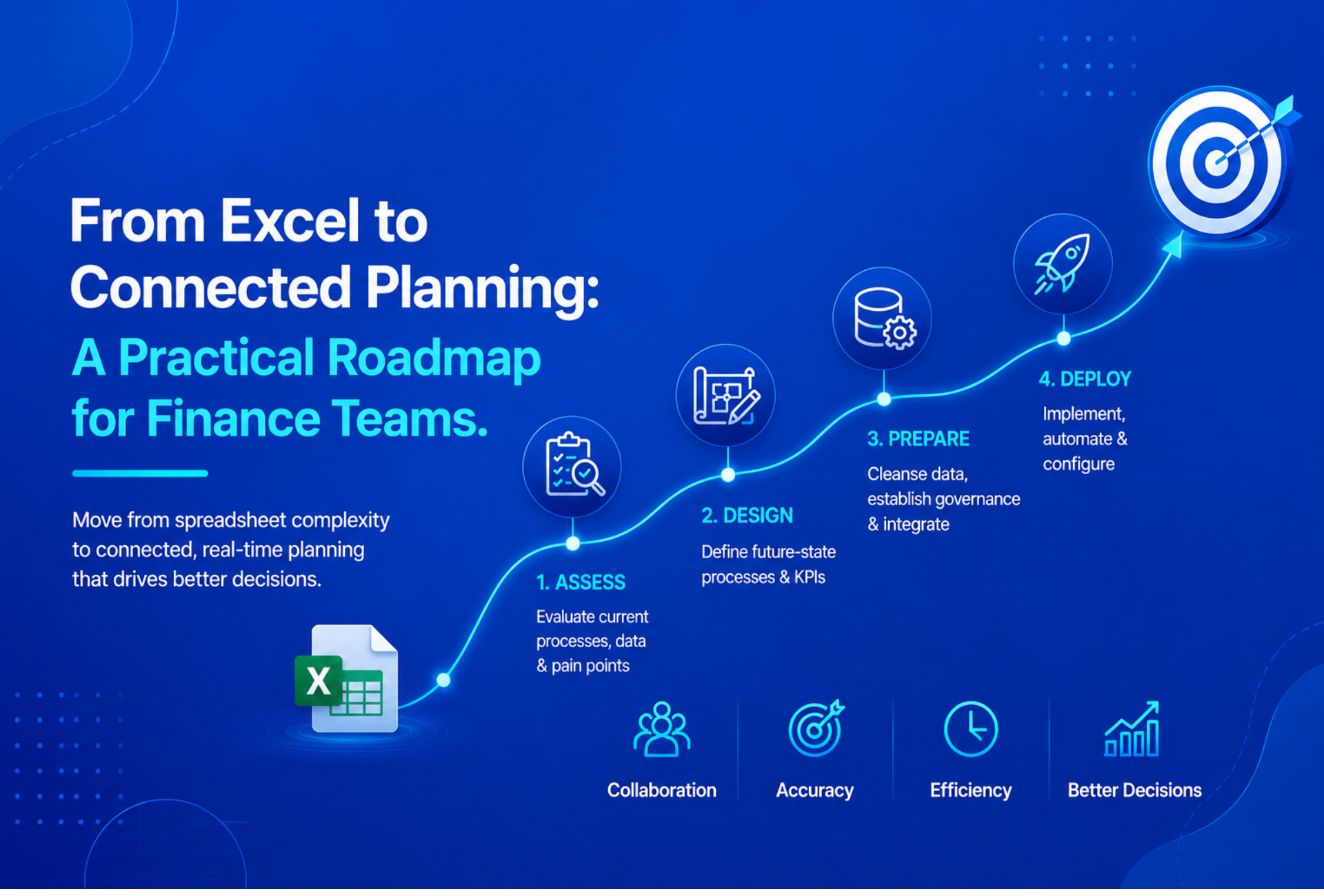
The most common mistake organizations make when transitioning to connected planning is trying to do too much at once. The organizations that transition successfully do it differently — they start narrow, prove value quickly, and expand deliberately.
Stabilize and Standardize Before You Migrate
Before moving any process off Excel, the most important work is understanding exactly what you have — documenting planning logic, standardizing definitions across business units, aligning on the chart of accounts, and identifying the most painful friction points in the current process. It is unglamorous work, and it determines whether the transition succeeds.
Start With the Highest-Pain Process
The right starting point is not the most complex process — it's the most painful one. For most organizations, that's the annual budget. A focused budget implementation keeps scope manageable and delivers immediate, visible relief that builds confidence for the phases that follow.
Expand to Forecasting and Rolling Planning
Once the budget process is stable, the natural next step is forecasting. When actuals flow automatically from the ERP into the planning model, finance stops spending most of its time on data gathering and starts spending most of it on analysis. The planning horizon shifts from backward-looking to forward-looking.
Connect Finance to the Business
This is the integration of financial planning with operational planning — sales, supply chain, workforce, and capital planning brought into the same environment as the financial plan. This phase requires the most change management; the technology is the easier part.
Build for Intelligence
Modern analytics and AI capabilities layer on top of the connected planning foundation — predictive forecasting, automated variance analysis, and natural language interfaces. These capabilities depend entirely on the quality of the planning infrastructure beneath them. Build the foundation first.
The technology decision is rarely where connected planning transformations succeed or fail. The more common failure points have nothing to do with the platform.
Data Readiness
The planning model is only as good as the data feeding it. Organizations that underinvest in data governance spend the first year reconciling inconsistencies that should have been resolved before go-live.
Change Management
Business unit leaders who've been submitting Excel templates for ten years don't automatically embrace a new process because it's technically superior. Adoption requires communication, training, and visible executive sponsorship.
Process Design
A connected planning platform configured around a broken process produces a faster, more visible version of the same broken outcomes. Process redesign and implementation need to happen together, not sequentially.
Scope Discipline
The impulse to solve every planning problem at once is understandable but consistently counterproductive. Phased implementations with clear success criteria outperform comprehensive big-bang transformations in nearly every case.
Excel got most finance functions to where they are today. It will not get them to where they need to be.
The organizations that plan most effectively, forecast most accurately, and make the fastest, most confident decisions are not the ones with the largest finance teams or the most sophisticated models. They are the ones that built a planning infrastructure that connects data, process, and people into a coherent operating model, and then continuously invested in making that infrastructure better.
The transition from spreadsheet-based planning to connected planning is not a technology project. It is a capability-building journey. And like any capability-building journey, the most important step is the first one: an honest assessment of where the current planning process is creating risk, and a disciplined plan for addressing it.
The roadmap exists. The question is when your organization decides to follow it.
Keansa works with CFOs, FP&A leaders, and finance transformation teams to assess planning maturity, design connected planning roadmaps, and implement modern EPM environments that move organizations beyond spreadsheet-driven planning.
Talk to a Keansa Consultant.png)
.png)
.png)