
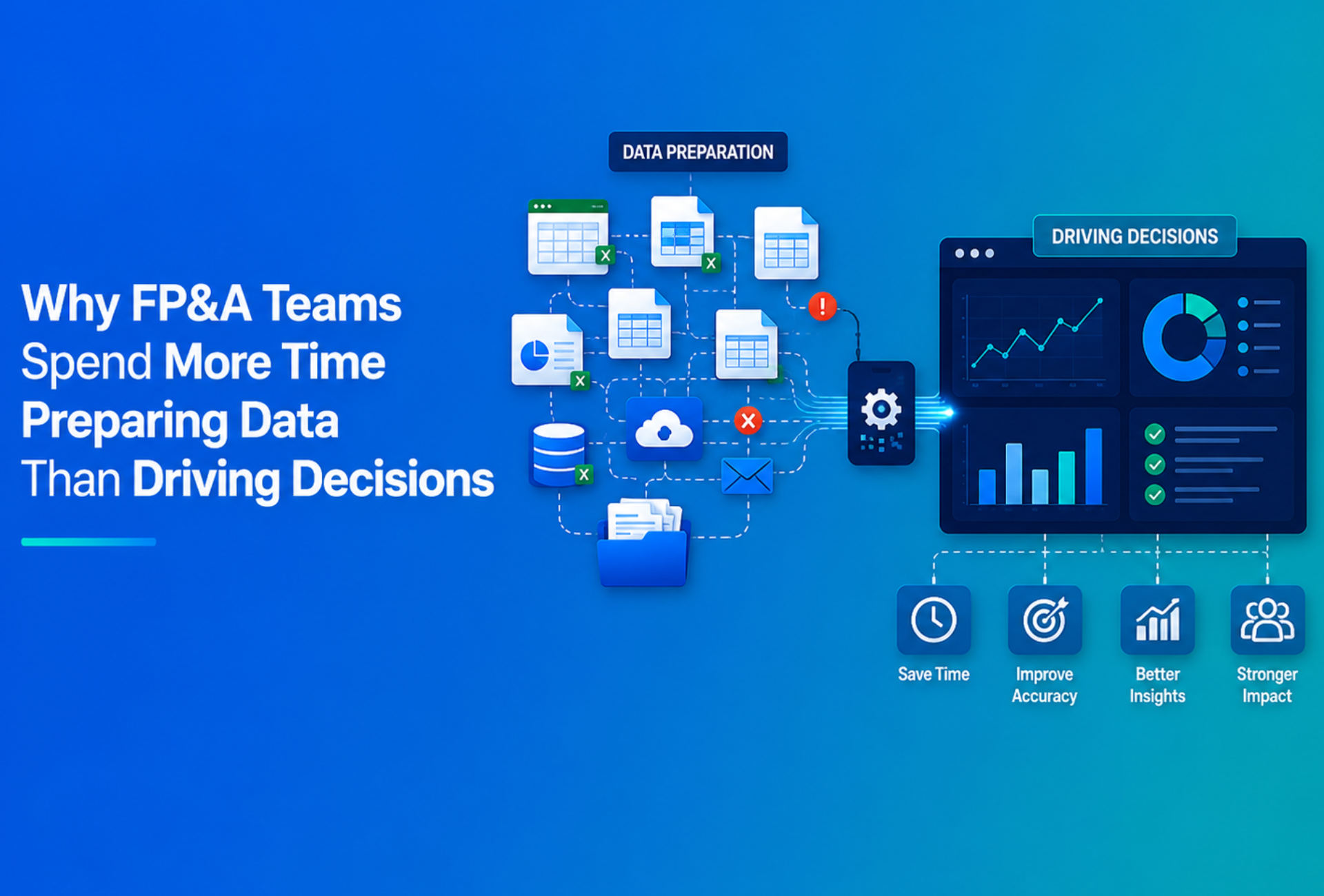
Ask most FP&A leaders what they wish their team did more of, and the answer is rarely "more reporting." It's more time in front of the business: shaping decisions, challenging assumptions, helping a GM decide where to place next quarter's investment. Ask what their team actually spends its week doing, and the honest answer is closer to chasing down a spreadsheet from a regional controller who hasn't sent it yet.
That gap, between the strategic role FP&A is supposed to play and the administrative work it actually does, isn't a motivation problem or a talent problem. It's a structural one. And it's far more common than most finance leaders would like to admit.
This isn't just a perception problem, and it isn't isolated to any one company or industry. When researchers actually measure how FP&A teams spend their time, the same pattern shows up again and again: most of the week goes to assembling numbers, not interpreting them.
A joint survey by the Association for Financial Professionals and APQC put a number on it. FP&A professionals spend only about a quarter of their time on genuine, value-added analysis. The rest goes into gathering data and administering the planning process itself, the unglamorous work of pulling numbers together and keeping the machinery running.
What makes this more than a one-off finding is how consistently it repeats. The FP&A Trends 2024 Survey, based on responses from more than 2,400 finance practitioners worldwide, found a strikingly similar imbalance: barely a third of FP&A time goes toward high-value work like generating insight, with the majority still absorbed by data collection and validation.
Different survey, different year, different population, same result. That's the real signal here. This isn't a rough quarter or a staffing gap at one company. It's what happens, almost everywhere, when FP&A operates on fragmented systems and manual processes rather than a connected data foundation.
It's tempting to treat this as a workload problem: hire more analysts, and the ratio improves. In practice, that rarely works, because the constraint isn't headcount. It's the condition of the data FP&A has to work with before any analysis can start.
None of this is a knock on the people doing the work. It's what happens when analytical talent is asked to operate inside a data environment that was never built to support fast, trustworthy analysis in the first place.
It's worth making this concrete. A typical monthly close and forecast cycle for a mid-enterprise FP&A team often looks something like this:
Somewhere in that sequence, the actual analysis — the part where someone asks whether the forecast makes sense given what's happening in the market — gets compressed into whatever time is left. It's rarely enough, and it's almost never the first thing that gets cut when a deadline tightens. It's usually the last thing left standing after everything else has already taken its share of the week.
It's easy to treat this as an efficiency issue: FP&A is slower than it should be, so the fix is speed. That undersells what's actually at stake.
When most of a team's time goes into assembling and validating data, a few consequences follow that have nothing to do with speed:
The 55% of executives in one industry survey who said their organization doesn't believe FP&A delivers high strategic value aren't necessarily wrong about the team's potential. They're describing what happens when that potential never gets the chance to show up, because it's buried under assembly work.
The shift from data manager to strategic partner isn't about asking FP&A to work harder or think more strategically. It's about removing the structural constraint that's been eating three-quarters of their time.
Modern EPM platforms tackle this at the source, not by making the spreadsheet faster, but by removing the need for most of the manual assembly in the first place:
None of this replaces analytical judgment. It removes the work that was never analytical judgment to begin with, and it's usually the majority of what was consuming FP&A's time.
The interesting part isn't the efficiency gain. It's what a finance team does once assembly stops eating most of the week.
Teams that have made this shift tend to describe the change less in terms of hours saved and more in terms of what they're now able to be asked. They get pulled into a pricing decision earlier, because they can model the impact in the meeting instead of promising an answer next week. They flag a margin risk before it shows up in the quarterly numbers, because they have time to actually look for it instead of just reporting what already happened. They become the team a business leader calls before a decision, not the team that explains it afterward.
That's the real distinction between a data manager and a strategic business partner. It was never about aptitude. It was about whether the role had room to operate as one.
Before evaluating any platform or process change, it's worth answering a more basic question honestly: where is your FP&A team's time actually going right now? Most organizations have never measured this directly, which means the case for change tends to stay anecdotal rather than concrete.
A short, deliberate assessment, tracking how many hours a typical cycle spends on data gathering versus validation versus actual analysis, tends to be more persuasive to a board than any platform comparison. It turns "our team feels stretched" into a specific, fixable problem with a number attached to it.
Keansa works with mid-enterprise finance teams to do exactly that: baselining where planning time is actually going, identifying the specific points where manual data work is displacing analysis, and building the data and process foundation that lets FP&A spend its time on judgment instead of assembly.
Related Reading
Keansa works with mid-enterprise finance teams to baseline where planning time is actually going, identify the specific points where manual data work is displacing analysis, and build the data and process foundation that lets FP&A spend its time on judgment instead of assembly.
Book a Planning Assessment →.png)
.png)
.png)