For three decades, Sales & Operations Planning has lived in the same organizational box: a supply chain discipline, owned by operations, measured by forecast accuracy and service levels, and reviewed once a month in a meeting Finance and Sales rarely attended with full attention.
That model made sense in a world of relatively stable demand, predictable lead times, and slow-moving cost structures. It does not make sense today.
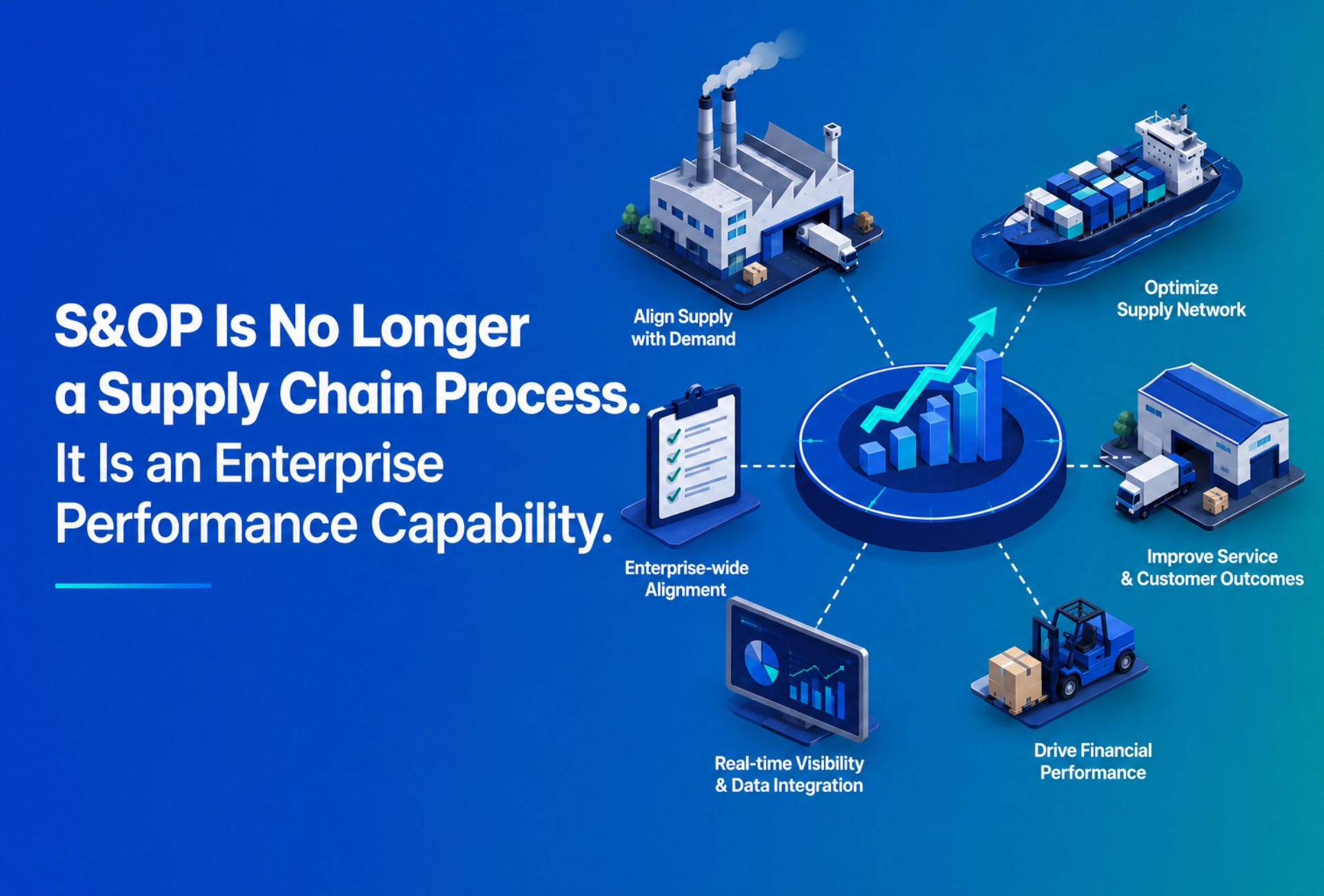
Over the past five years, the organizations that have weathered supply shocks, demand volatility, margin compression, and geopolitical disruption with the least damage share a common trait: they stopped treating S&OP as a supply chain ritual and started treating it as an enterprise performance capability, one that sits alongside financial planning, capital allocation, and strategic execution as a core driver of business performance.
This is not a semantic shift. It is a structural one, and it has direct implications for how CFOs, COOs, CIOs, and functional leaders should be organizing planning, data, and decision rights inside their organizations.
The Traditional View of S&OP Has Reached Its Limits
Classic S&OP was designed to solve a specific problem: reconcile a demand forecast with a supply plan, on a monthly cadence, so operations could commit to a production and inventory plan with reasonable confidence.
It worked well enough when the primary variable was volume. But three shifts have exposed the limits of that design:
Volatility has become the baseline, not the exception
Demand signals shift weekly, not monthly. Input costs move faster than a standard S&OP cycle can absorb. A process built to run once a month cannot govern a business that needs to respond in days.
The financial consequences of supply chain decisions have become too large to review after the fact
A capacity decision, a sourcing shift, or an inventory build no longer sits quietly inside operations. It shows up immediately in working capital, gross margin, and cash flow. When Finance only sees the output of S&OP after the plan is locked, the organization is managing financial risk in the rearview mirror.
Supply chain decisions increasingly are strategic decisions
Where to manufacture, which markets to prioritize when supply is constrained, and how to trade off service level against margin are not operational questions anymore. They are enterprise questions, and they require the same rigor, transparency, and cross-functional ownership that capital allocation decisions receive.
Put simply: the classic model of S&OP was built to answer "can we supply the plan?" Today's organizations need a process that also answers "should we, and what does it do to the P&L, the balance sheet, and our strategic position?" That question cannot be answered inside supply chain alone.
From S&OP to an Enterprise Performance Capability
The organizations getting this right have not abandoned S&OP. They have elevated it, expanding its scope, its stakeholder base, and its connection to financial and strategic planning. In practice, this evolution shows up in three ways.
1
The planning horizon and cadence have changed
Rather than a single monthly cycle culminating in an executive S&OP meeting, leading organizations run a continuous planning rhythm: shorter, more frequent operational reviews feeding into a strategic planning layer that looks 12 to 24 months out. Speed matters as much as accuracy now, because the cost of a slow, accurate answer is often higher than a fast, directionally right one.
2
The stakeholder map has broadened
Finance is no longer a downstream recipient of the supply plan. It is a co-owner of the process, translating volume and capacity decisions into margin, cash, and capital impact in real time. Sales and commercial leaders are expected to bring not just a forecast, but the assumptions and risk behind it. Procurement is pulled in earlier, because sourcing and supply risk now materially affect the plan's financial outcome, not just its feasibility.
3
The output of the process has changed
Traditional S&OP produced an operational plan. An elevated S&OP process produces a financially reconciled, cross-functional view of enterprise performance: one plan, expressed consistently in units, revenue, cost, and cash, that Finance, Operations, and Sales can all stand behind.
This is precisely where S&OP intersects with Enterprise Performance Management. EPM has always been about connecting strategy, planning, and execution through a consistent set of numbers. Historically, EPM lived primarily in Finance: budgets, forecasts, consolidation, close. S&OP lived in Operations: demand and supply balancing. The organizations pulling ahead today have effectively merged the two: the S&OP process has become one of the primary inputs into the enterprise's rolling financial forecast, and the enterprise's financial constraints have become a first-class input into the S&OP decision, not an afterthought applied after the plan is set.
Why This Matters More Than a Process Redesign
It is tempting to treat this as an operational improvement project: better meetings, tighter cadences, cleaner dashboards. The organizations that get the most value from this shift understand it differently: it is a decision-rights and governance question before it is a process question.
When S&OP operates as a standalone supply chain process, decisions get made with partial information, and the organization pays for it downstream in one of three ways.
Misallocated capital
Capacity and inventory investments get approved based on a plan that Finance did not fully stress-test against margin and cash constraints, and the true cost only becomes visible in the next financial close.
Slow, defensive decision-making
Without a shared, trusted number, every cross-functional decision becomes a negotiation over whose data is right, rather than a discussion about what to do next. This is often the single biggest hidden cost of disconnected planning: not the bad decisions, but the decisions that take three times longer than they should.
Strategic drift
The annual strategic plan and the monthly operating plan live in different systems, owned by different teams, reconciled by spreadsheet. Over a year, the gap between "what we said we'd do" and "what we're actually doing" widens quietly until a board or investor conversation forces an uncomfortable reconciliation.
None of these are supply chain problems in the traditional sense. They are enterprise performance problems, and they require the same discipline — common data, common assumptions, clear ownership, and a governed cadence — that leading organizations already apply to financial planning and reporting.
What an Enterprise-Grade S&OP Capability Looks Like
Organizations that have made this transition successfully tend to build around four structural pillars, rather than a single new meeting or tool.
A shared planning foundation
Demand, supply, and financial plans are built on a common data model and a common set of assumptions, rather than three separate spreadsheets reconciled by hand at month-end. This does not require a single monolithic system, but it does require that the numbers Sales, Operations, and Finance are each working from can be traced back to the same source of truth.
Financially fluent planning, not just volume planning
Every material planning decision — whether a capacity investment, a sourcing change, or a service-level trade-off — is expressed in financial terms as part of the process, not translated afterward. This is what allows a CFO to sit in an S&OP review and evaluate it with the same rigor as a capital request.
Scenario capability as a standing muscle, not a crisis response
The organizations that navigated recent disruption well were not the ones with the most accurate forecast. They were the ones that could stand up three or four credible alternative plans within days and evaluate the financial and operational consequences of each. Scenario planning built into the operating cadence, not assembled under pressure, is now a genuine competitive differentiator.
Clear, cross-functional governance
Someone owns the decision when Sales, Operations, and Finance disagree, and that ownership is defined before the disagreement happens, not negotiated in the moment. In the most mature organizations, this typically sits with a cross-functional executive forum that reviews the integrated plan monthly, with real authority to trade off growth, margin, and service level against each other.
This is, in substance, Integrated Business Planning: the natural evolution of S&OP once it is fully connected to financial and strategic planning. The label matters less than the underlying shift: planning stops being something Operations does and Finance reviews, and becomes something the enterprise does together, on a shared foundation, with a shared number.
The Leadership Imperative
CFO
For CFOs
This is an invitation to move upstream: from validating the financial impact of operational decisions after the fact, to shaping those decisions as they're made. The finance functions that are winning this mandate are the ones building the connected data and forecasting capability to participate in real time, not the ones simply asking for better reports.
COO
For COOs and supply chain leaders
It is a chance to reposition planning as a strategic function with a seat in enterprise decision-making, rather than a service function that executes against targets set elsewhere.
CIO
For CIOs
It reframes the technology conversation. The question is not which planning tool has the best demand forecasting algorithm. It is whether the organization's planning architecture — meaning its data, systems, and process — can support one connected view of enterprise performance across Finance, Sales, and Operations, updated continuously rather than reconciled monthly.
🏢
For the enterprise as a whole
It is a recognition that in a volatile environment, the ability to plan, replan, and align quickly across functions is no longer a supporting capability. It is a source of competitive advantage in its own right.
Closing Thought
The organizations that will outperform over the next planning cycle are not the ones with the most sophisticated forecasting model. They are the ones that have stopped asking Sales, Operations, and Finance to reconcile three different versions of the future, and started building one enterprise performance capability that all three can trust, act on, and be measured against together.
S&OP was never really a supply chain process. It was always a proxy for how well an organization could align its people, its numbers, and its decisions. Treating it that way — as core enterprise infrastructure rather than a departmental routine — is quickly becoming the dividing line between organizations that plan their way through disruption and organizations that are managed by it.
Related Resources
Keansa works with finance, operations, and supply chain leaders to design and implement connected planning capabilities that turn S&OP into a true enterprise performance discipline. If your organization is evaluating what this transition looks like in practice, we'd welcome the conversation.
Book a Free Planning Assessment →
.png)
.png)
.png)