Most Enterprise Performance Management projects that struggle aren't undone by the software. They're undone by an organization that wasn't ready for the change the software required. The platform goes live on schedule, and six months later half the finance team is still keeping a shadow spreadsheet, not because the tool failed, but because the planning processes, data, and habits it was meant to support were never mature enough to carry it.
Successful EPM initiatives start with an honest assessment of organizational readiness, not platform selection.
What Does EPM Readiness Mean?
EPM readiness is an organization's ability to successfully adopt, use, and scale an Enterprise Performance Management platform, not just install one. It extends well past technology into:
- Business processes — whether planning workflows are defined clearly enough to configure a platform around
- Data quality — whether the numbers feeding the platform are trustworthy and consistently structured
- Governance — whether roles, ownership, and controls around planning are actually clear
- People — whether finance has the capacity and skills the new way of working requires
- Planning maturity — whether the organization already practices disciplined forecasting, even informally
- Executive sponsorship — whether leadership will drive adoption, not just approve budget
- Change management — whether there's a real plan for how the organization adopts new ways of working
An organization can be technologically ready and still be organizationally unready if these other dimensions haven't been addressed.
Seven Signs Your Organization Is Ready for EPM
1
Heavy reliance on spreadsheets for core financial planning
2
Long budgeting and forecasting cycles that keep stretching, not shrinking
3
Multiple versions of the truth across finance, sales, and operations
4
Manual consolidation across ERP systems eating disproportionate time
5
Growing demand for scenario planning that spreadsheets can't keep pace with
6
Difficulty responding to business change in the plan itself
7
Executive demand for real-time insights finance can't easily provide
Several of these appearing together, consistently, is a stronger signal than any one alone.
The EPM Readiness Framework
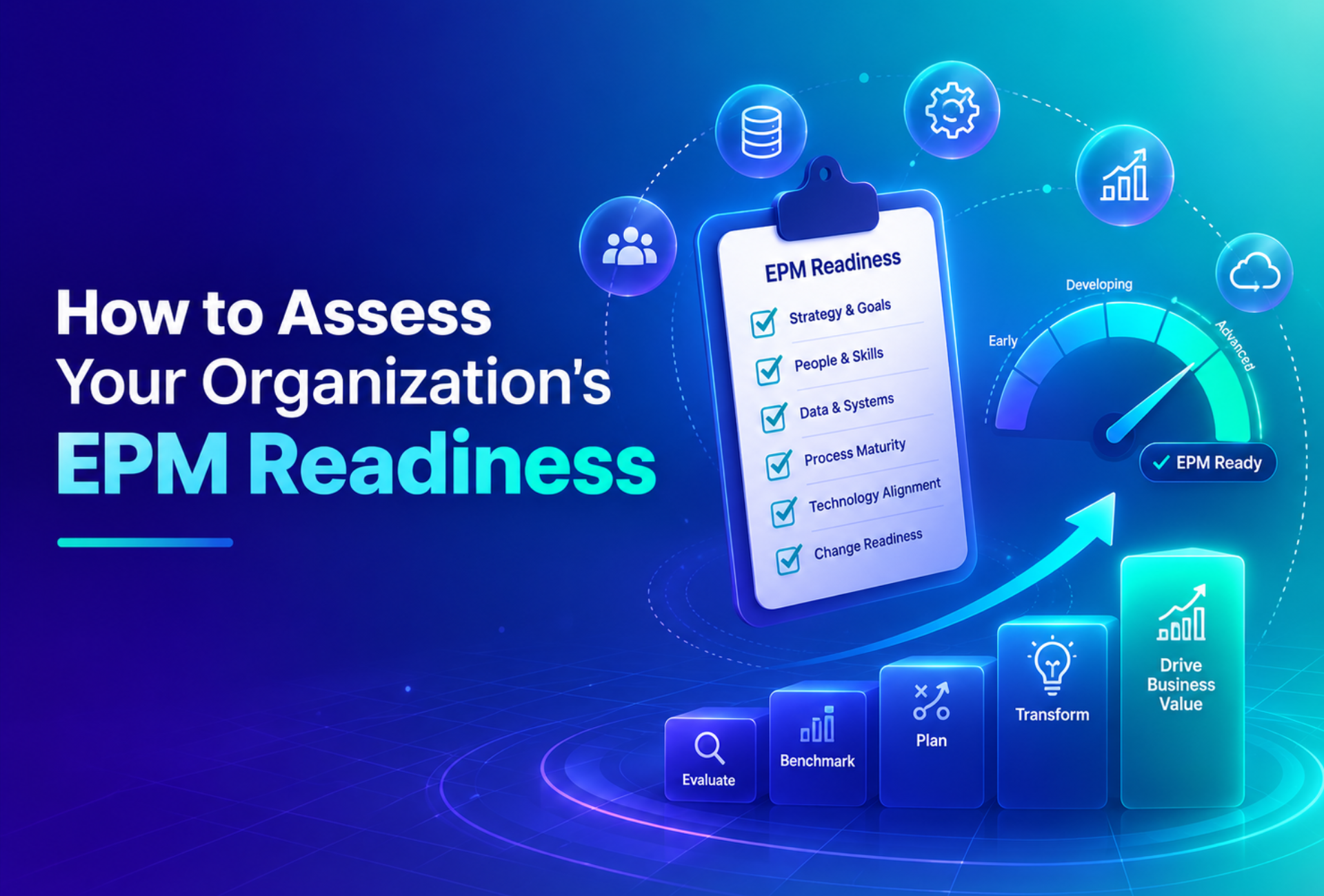
Readiness is best evaluated across six dimensions.
Why It Matters
A platform can only support planning that's actually defined
Warning Signs
Workflows that vary by team, no documented approval chain
Best Practice
Standardize and document core planning processes before implementation
Why It Matters
A sophisticated platform built on poor data just produces poor answers faster
Warning Signs
Inconsistent master data, no agreed single source of truth
Best Practice
Establish master data governance as its own workstream before go-live
Why It Matters
Well-designed processes fail if the technical environment can't support them
Warning Signs
ERPs that aren't integration-ready, unclear cloud readiness
Best Practice
Assess integration capability early, not as an afterthought
Why It Matters
Technology doesn't plan, people do
Warning Signs
Finance spending most of its time on data assembly, no clear business owner
Best Practice
Build a genuine adoption plan, not a single training session
Why It Matters
Planning without clear ownership inherits the same ambiguity that made the old process slow
Warning Signs
Unclear roles, no defined planning ownership
Best Practice
Define roles, responsibilities, and controls explicitly before implementation
Why It Matters
Initiatives without a clear rationale lose momentum the moment implementation gets hard
Warning Signs
No named executive sponsor, shifting objectives
Best Practice
Secure real sponsorship and align the initiative to business strategy, not just IT
A Practical EPM Readiness Scorecard
Rate each dimension from 1 (Not Ready) to 5 (Highly Ready):
| Dimension |
1 — Not Ready |
3 — Partially Ready |
5 — Highly Ready |
| Business Processes |
Undocumented, inconsistent |
Documented but siloed |
Standardized, connected |
| Data |
Fragmented, no single truth |
Mostly consistent, gaps remain |
Governed, single source of truth |
| Technology |
Legacy, no integration path |
Partial integration capability |
Cloud-ready, integration-capable |
| People |
Unclear ownership, limited capacity |
Some capability, unclear ownership |
Strong capability, clear ownership |
| Governance |
No defined roles |
Roles exist, inconsistently followed |
Clear roles and controls |
| Strategy |
No sponsorship, unclear goals |
Sponsorship exists, vague goals |
Strong sponsorship, clear alignment |
Interpreting your score:
Mostly 1s & 2s
Readiness-Building Phase
Readiness-building should be its own phase before implementation begins
Mixed Profile
Sequence Around Constraints
Usually points to one or two real constraints worth sequencing around first
Consistent 4s & 5s
Ready for Platform Evaluation
The organization is likely ready to move into platform evaluation
Common Mistakes Organizations Make
✕
Buying software before redesigning planning processes
✕
Ignoring change management as a separate workstream
✕
Assuming technology alone solves planning challenges
✕
Poor data governance, discovered mid-implementation
✕
Limited or fading executive sponsorship
✕
Treating EPM as an IT initiative instead of a business transformation program
What to Do Before Starting an EPM Project
✓
Document current planning processes end to end, including workarounds
✓
Clean and standardize planning data, with a clear source of truth
✓
Align business stakeholders before requirements get finalized
✓
Define success metrics up front
✓
Build a business case around specific decisions, not just efficiency
✓
Create a phased roadmap sequenced around actual readiness gaps
✓
Select an implementation partner with cross-platform experience
Where Keansa Helps
This is precisely where Keansa starts, before any platform enters the conversation. Rather than beginning with a vendor shortlist, Keansa works with finance and technology leaders to assess readiness across all six dimensions — business processes, data, technology, people, governance, and strategy — producing an honest baseline of where the organization already has a solid foundation and where the real gaps sit.
Because that assessment is independent of any specific platform, it results in a sequencing plan built around your organization's actual readiness rather than a generic rollout, closing the highest-priority gaps first and setting up platform selection and implementation to succeed rather than stall.
Conclusion
EPM success depends far more on organizational readiness than on which platform ultimately gets selected. Organizations that assess their readiness honestly before starting tend to see faster adoption, stronger ROI, and planning capability that actually holds up over time.
Not sure where your organization sits across these six dimensions? Keansa's readiness assessment gives you an honest baseline — independent of any platform — so your EPM initiative is sequenced around your actual gaps, not a generic rollout.
Book a Planning Assessment →
.png)
.png)
.png)