
Key Takeaway
The average budgeting cycle still takes nearly nine weeks, unchanged in three years, despite record investment in planning software. That's not a tooling problem. It's a sign that the annual budget itself, as an operating rhythm, has stopped matching how fast the business actually moves.
Every finance team knows the feeling. The budget goes through months of review, gets presented, gets approved, and gets locked. Then reality moves. A market shifts, a competitor changes pricing, a key account churns, and the plan that took a quarter to build is already out of date within weeks of going live.
This isn't a new complaint. What's changed is the cost of ignoring it. According to AFP's 2026 research, the average budgeting cycle still takes close to nine weeks, a number that hasn't meaningfully moved in three years despite finance teams investing more heavily in planning software than ever before. The FP&A software market itself has grown to somewhere between $4.4 and $5.8 billion, expanding at roughly 10% a year. Spend on tools is going up. Cycle time isn't going down.
That gap is the real story. It means the annual budget's problem was never really about speed of execution. It's about the operating rhythm itself.
A budget produced in October is already partially wrong by January. By June, in a lot of businesses, it's close to fiction. Not because the finance team did a bad job building it, but because it was built to answer one question, "what are we planning to do this year," and locked in place before the year actually started unfolding.
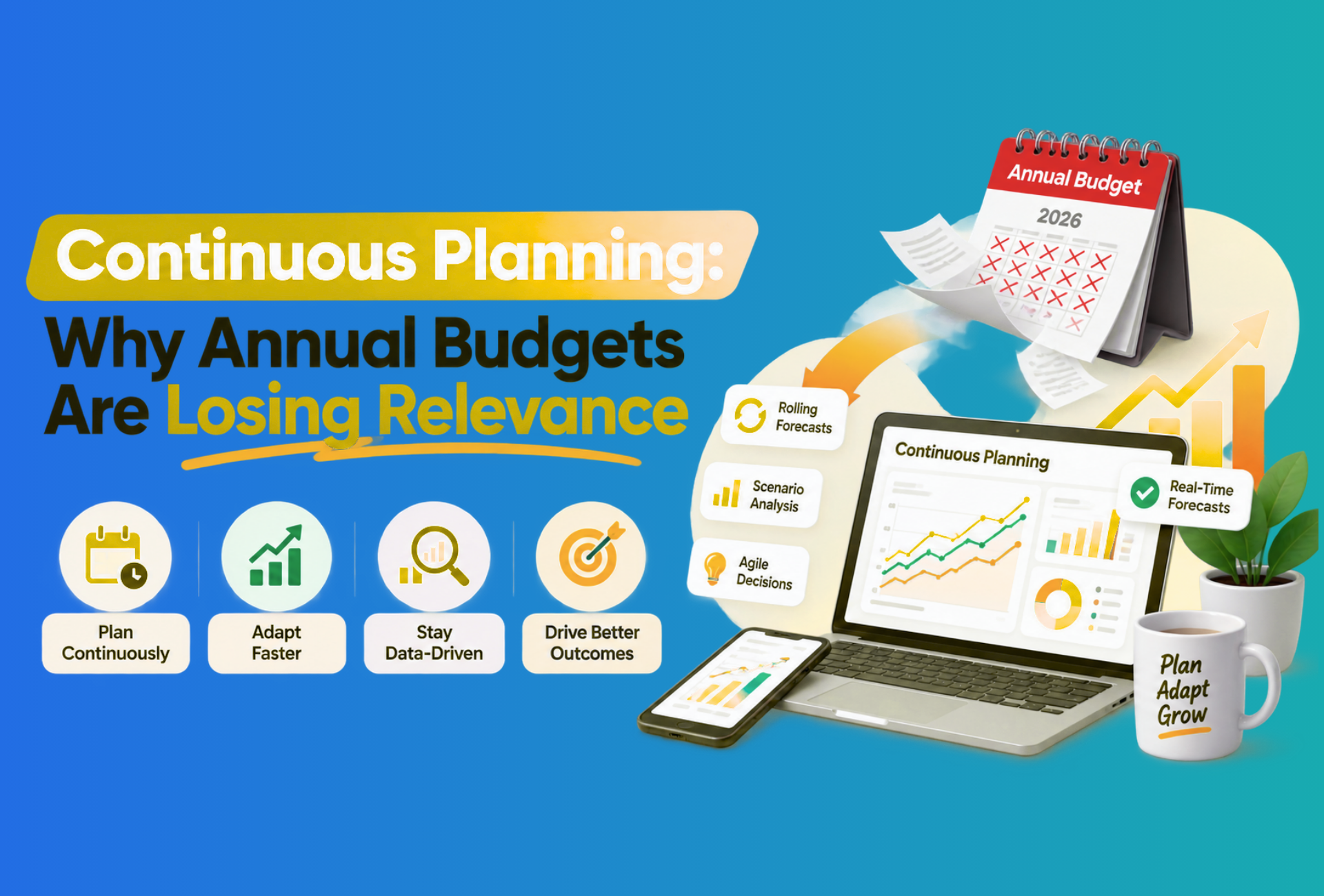
Continuous planning starts from a different premise. Instead of treating the plan as a document finished once a year, it treats the plan as a living model that updates as assumptions change: when pipeline shifts, the forecast reflects it within days, not at the next scheduled review. When headcount or cost assumptions move, the model recalculates instead of waiting for a formal reforecast request to work its way through the calendar.
The old cycle answers "what did we agree to." Continuous planning is built to answer a more useful question: "what should we do now, given everything we know today."
It's worth being precise about what continuous planning actually replaces, because it isn't the annual budget itself. Most organisations that adopt continuous planning still produce an annual budget every year, for governance, for compensation benchmarks, for board approval. Those are legitimate uses a rolling forecast doesn't replace.
What changes is the role that budget plays day to day. In a traditional model, the annual budget is the plan, the single fixed document performance gets measured against for twelve months. In a continuous planning model, the budget becomes a baseline artifact, a reference point set once a year. The rolling forecast becomes the actual operational plan that drives decisions, updated as often as the business needs it to be.
Organisations that make this shift tend to redefine how they measure themselves along the way. Instead of focusing almost entirely on variance to the original budget, they shift attention toward variance to the latest forecast, the trend underneath the numbers, and the quality of the assumptions driving the projection forward.
That's a different conversation in the monthly review. Instead of "why didn't you hit budget," the question becomes "what's changed since the last forecast, and how are you responding to it." One is backward looking and often unanswerable in any useful way six months after the fact. The other is exactly the conversation a business actually needs to be having in real time.
Faster, Better Capital Allocation
When leadership has a current view of performance and outlook, resources can move to higher-value opportunities without waiting for the next scheduled budget cycle. A strategic initiative doesn't need to sit idle for months just because the funding conversation hasn't come up yet on the calendar.
More Credible Numbers for Boards and Lenders
Board members, investors, and lenders place more trust in a forecast that's regularly updated and checked against actual performance than in a static projection nobody has revisited since it was approved.
A Foundation Every Other EPM Capability Depends On
Scenario modelling, driver-based forecasting, real-time analytics, none of it delivers its full value inside an organisation still fundamentally run on an annual cycle. Continuous planning is less a feature to switch on and more the operating shift that lets everything else actually work the way it's supposed to.
If continuous planning is clearly better, why hasn't every finance team already moved to it? Industry analysis of CFO surveys from Gartner and McKinsey suggests adoption is accelerating but hasn't yet reached a clear tipping point, and the honest answer for most organisations is that the barrier is rarely the software.
The more common blocker is simply getting started. Someone has to build the first model, decide which planning area to tackle first, whether that's operating expense, revenue, workforce, or capital, and get the organisation comfortable updating a plan more often than once a year. Sequential adoption tends to work better than trying to overhaul the entire planning process at once: get the base rolling forecast running reliably first, then layer in reforecasting cadence, then scenario modelling, rather than attempting all of it in a single implementation.
Not because spreadsheets are useless. They're genuinely useful for a lot of things. But they were never designed to be the operating system for a planning process that updates continuously rather than once a year.
Most finance teams don't need to replace their annual budget process to begin this shift. The more practical path is running a rolling forecast alongside the existing budget, updated monthly or quarterly, so leadership has a current forward view in addition to the fixed annual plan. As confidence in that rolling view grows and decisions start being made from it instead of the static budget, the annual process itself tends to simplify, because it's no longer being rebuilt from zero every year.
The question isn't really whether continuous planning delivers more value than an annual budget locked in October and defended through the following summer. It's how quickly an organisation is willing to build the operating rhythm that makes it possible.
Keansa works with FP&A leaders to design rolling forecast cadences, driver-based planning models, and connected EPM environments that move finance from an annual event to a continuous operating rhythm.
Talk to a Keansa Consultant.png)
.png)
.png)