
Most finance leaders understand, at least in theory, that their planning processes are more fragmented than they should be. Finance builds the budget in one system. Supply Chain runs its demand plan in another. HR manages headcount in a third. And at the end of each month, someone spends three days trying to reconcile them all.
This is the silo problem — and it is far more expensive than most organisations realise. Connected planning is the discipline and technology approach designed to solve it. This guide explains what connected planning actually means, why siloed budgeting costs more than it appears to, and what finance leaders need to know to move forward.
What Is Connected Planning?
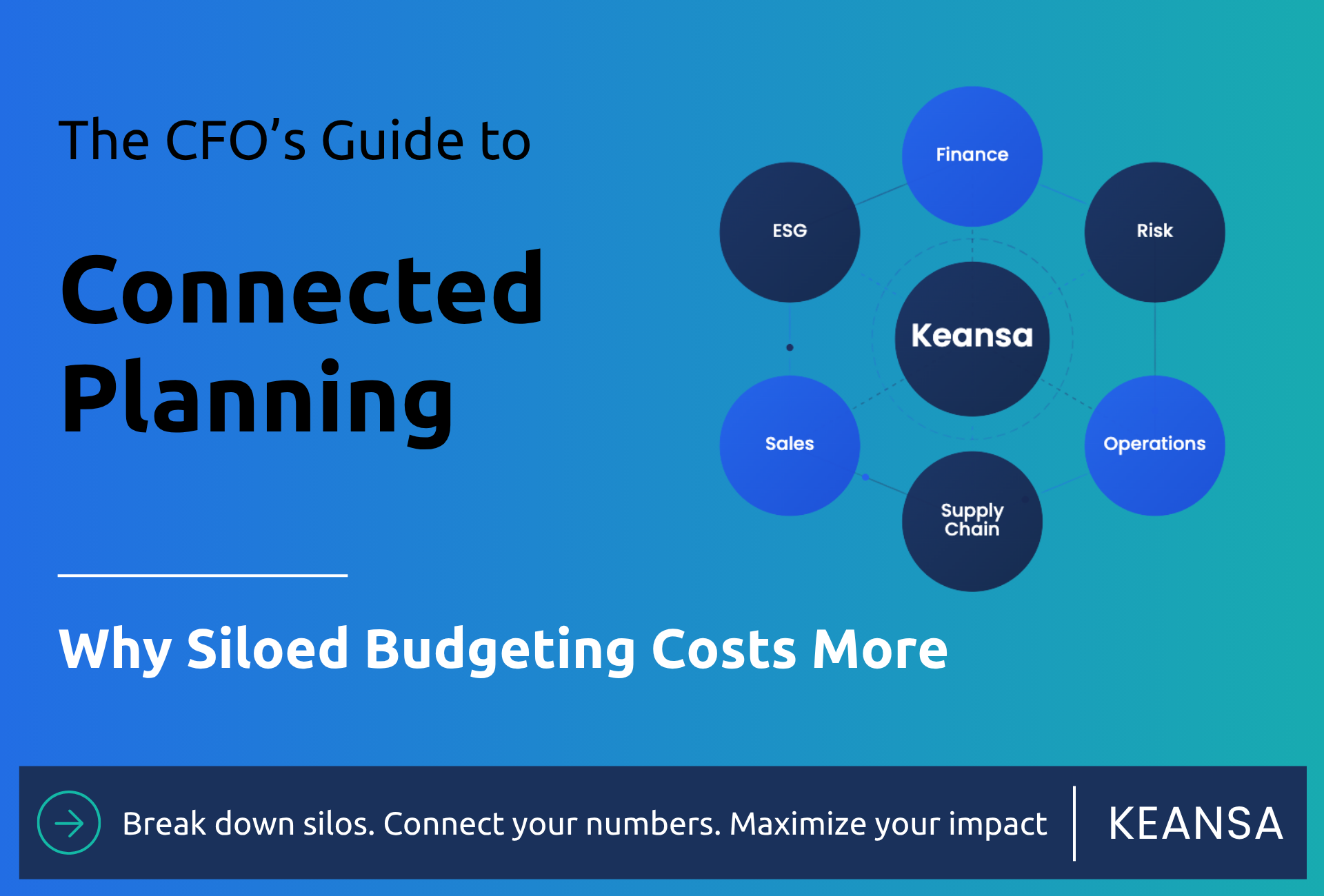
Connected planning is an approach to enterprise planning that links financial, operational, and strategic plans across departments — Finance, Supply Chain, Sales, HR, and Operations — into a single, integrated model that updates in real time.
Rather than each department maintaining its own version of the plan in its own system, connected planning creates a shared planning environment where a change in one area — say, a demand forecast revision from Sales — immediately flows through to the financial model, the supply plan, and the workforce plan.
The term was popularised by Anaplan but is now used broadly to describe the capabilities that modern EPM (Enterprise Performance Management) platforms deliver. The underlying principle is simple: plans that don't talk to each other can't drive the business forward together.
Why Siloed Budgeting Costs More Than You Think
The cost of siloed planning is rarely captured in a single line item — which is part of why it persists for so long before organisations address it. It shows up across multiple areas simultaneously, making it easy to attribute to other causes.
What Connected Planning Looks Like in Practice
Connected planning is not simply about buying a new piece of software. It is about redesigning how planning information flows across the organisation — and then using technology to sustain that flow automatically. Here is what it looks like when it is working well:
The Five Planning Domains That Need to Be Connected
Connected planning is not just about connecting Finance to itself. A mature connected planning environment links five distinct planning domains into a coherent whole:
| Planning Domain | What It Covers | Why Connection Matters |
|---|---|---|
| Financial Planning (FP&A) | Budgeting, forecasting, P&L, cash flow, consolidation | The financial impact of all operational decisions must flow here in real time |
| Sales & Revenue Planning | Revenue targets, pipeline, pricing, territory planning | Revenue assumptions drive the entire financial model — they must be live, not static |
| Supply Chain & Operations | Demand forecasting, inventory, capacity, procurement | Operational plans must respond to financial constraints and revenue signals simultaneously |
| Workforce Planning | Headcount, compensation, hiring plans, attrition | People costs are typically 60–70% of operating costs — they must be modelled in real time |
| ESG & Sustainability | Emissions targets, energy use, disclosure reporting | ESG commitments increasingly affect capital allocation and require integration with financial planning |
Most organisations start by connecting Financial Planning with one other domain — typically either Supply Chain or Sales. That first connection is where the most immediate value is realised, and it builds the foundation for broader integration over time.
Common Barriers to Connected Planning — and How to Address Them
1. "Our data isn't clean enough"
This is the most common objection — and the most circular. Organisations defer connected planning because their data is messy, but the data stays messy in part because there is no single planning environment forcing consistency. The right approach is to start with the data you have, define the minimum quality threshold required for planning purposes, and build data governance in parallel with the implementation — not as a prerequisite.
2. "The business units won't adopt it"
Adoption resistance is almost always a design problem, not a people problem. When business units are forced to use a system that was built for Finance without their input, adoption fails. Connected planning implementations that succeed involve business unit leads in the design process from the start — building models that reflect how they actually plan, not how Finance thinks they should plan.
3. "We don't have the IT bandwidth"
Modern EPM platforms — Jedox, BOARD, Anaplan, OneStream — are cloud-native and designed to be managed by Finance, not IT. Implementation does require IT involvement for integration with source systems, but the ongoing administration of the planning model typically sits with a Finance-side power user or Centre of Excellence, not the IT department.
4. "We can't afford it"
The ROI case for connected planning is almost always positive when the full cost of the status quo is properly quantified — reconciliation hours, delayed decisions, forecast errors, and planning cycle inefficiencies. The question is not whether the investment pays back, but how quickly and what the right platform is for the organisation's size and complexity.
Where to Start: A Practical Framework
The most effective connected planning implementations follow a clear progression — not trying to connect everything at once, but building connectivity incrementally with clear value at each stage.
Most mid-market organisations reach Phase 2 within 12 months of starting. Phase 4 is typically a 2–3 year journey — not because the technology is slow, but because the organisational change required to sustain fully connected planning takes time to embed.
The Bottom Line
Siloed budgeting is not simply an inefficiency — it is a structural constraint on what the business can achieve. When Finance, Sales, Supply Chain, and Operations are all planning on different numbers in different systems, the organisation cannot respond to change quickly, cannot model trade-offs accurately, and cannot align resources to strategy effectively.
Connected planning removes that constraint. It does not happen overnight, and it requires both technology and organisational commitment. But for any mid-enterprise finance leader who has spent a month-end wondering why the numbers don't add up — it is the most impactful investment available.
Keansa helps mid-enterprise Finance teams move from fragmented spreadsheet planning to connected, real-time planning environments. If you're ready to understand what connected planning looks like for your organisation, let's talk.
Book a Planning Assessment.png)
.png)
.png)