Key Takeaway
Adoption of finance automation is nearly universal. Measurable ROI is not. According to Deloitte's 2026 Finance Trends report, 63% of finance teams have fully deployed AI — but only 21% report clear, measurable return on it. The gap isn't the technology. It's where you point it.
Almost every finance leader has invested in some form of automation by now. Very few can point to a number that proves it worked.
That's not a contradiction — it's a pattern showing up across the industry's most current research. Deployment has moved fast. Workflow redesign and ROI measurement have not kept pace with it. Teams are running automation tools inside processes that were never redesigned to take advantage of them, which is why the technology gets adopted but the return doesn't show up.
The finance teams actually seeing fast, measurable ROI aren't the ones who automated the most. They're the ones who automated the right three or four workflows first.
A few patterns explain the gap between how much finance teams have automated and how much of it is actually paying off.
Tools Get Bought Before Workflows Get Redesigned
Automation delivers value by removing manual steps, not by sitting on top of them. A tool layered onto a process that still routes approvals by email, still reconciles in spreadsheets, or still requires manual data re-entry between systems captures a fraction of the available return — because the workflow around it was never actually redesigned.
Readiness Lags Expectation
Industry surveys consistently find that a large majority of finance and accounting professionals expect AI to be the most transformative technology in their function over the next one to two years — but only a small fraction describe their organisation as genuinely well prepared for it. That gap between expectation and readiness is exactly where automation investments stall.
Isolated Tools Beat Point Solutions, Not Connected Workflows
A single automated task — one bot, one workflow — produces a local efficiency gain. It rarely produces enterprise-level ROI on its own, because the surrounding process still depends on manual handoffs before and after it. The teams getting the fastest, most measurable returns are automating connected workflows, not isolated tasks.
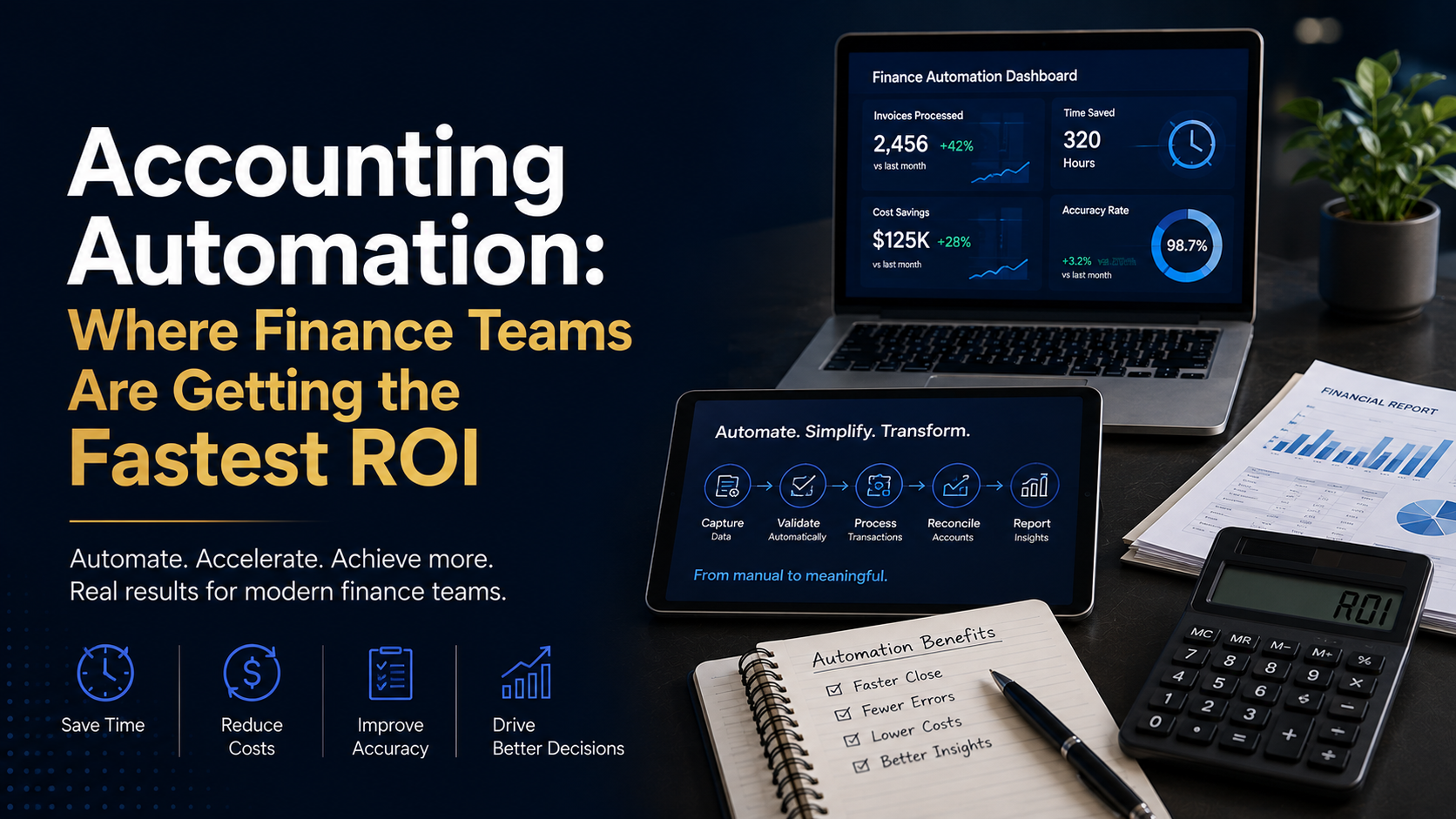
Not all accounting automation pays back at the same speed. Three workflows consistently show up as the highest-ROI starting points across current industry benchmarks.
Accounts Payable and Invoice Automation
This is the most mature and most measurable automation category in finance. Best-in-class AP teams now process invoices in roughly 3.1 days, compared to 17.4 days for teams still running largely manual processes. With over half of enterprise invoice volume now arriving digitally, the business case is straightforward: fewer manual keystrokes, faster three-way matching, and a payback period that typically lands well inside a year.
Bank Reconciliation and Close Acceleration
Reconciliation is repetitive, rules-based, and historically consumes a disproportionate share of the close calendar. Automating it directly compresses the close timeline and cuts the manual error rate that follows a rushed, spreadsheet-driven reconciliation process — making it one of the fastest-payback automation investments a finance team can make.
Expense and Anomaly Detection
Rather than reviewing every transaction manually, anomaly detection flags the transactions that actually deviate from expected patterns — policy violations, duplicate payments, unusual vendor activity — so review time concentrates on genuine risk instead of being spread evenly across every line item regardless of risk level.
All three share a common feature: they replace high-volume, rules-based manual work with a system that gets faster and more accurate the longer it runs — which is exactly the profile of a fast-payback automation investment.
The difference between an automation investment that pays back in six months and one that never shows a measurable return usually comes down to three things.
Sequencing
Start with the highest-volume, most rules-based workflow, not the most visible one. AP automation and reconciliation tend to deliver faster, more measurable returns than more ambitious but less mature use cases, simply because the process is well understood and the automation logic is straightforward to build correctly.
Data Quality Going In
Automation applied to inconsistent chart of accounts structures, unreconciled sub-ledgers, or unclear vendor master data will automate the inconsistency along with the task. Establishing clean, governed data before automation goes live is what separates a workflow that scales from one that has to be manually corrected every cycle.
Connection to the Rest of Planning
Accounting automation that feeds directly into a connected planning and reporting environment compounds in value — actuals flow into forecasts without a manual re-entry step, and the capacity freed up by automation gets redirected toward analysis rather than absorbed by a different manual task elsewhere in the close cycle.
Keansa's accounting automation practice focuses on the workflows that deliver measurable ROI fastest — accounts payable, reconciliation, and close acceleration — and connects that automation directly into the broader financial planning environment, so the time it frees up shows up as capacity for analysis, not just a faster version of the same manual process.
Not sure which accounting workflows would pay back fastest for your team?
Talk to a Keansa Consultant.png)
.png)
.png)